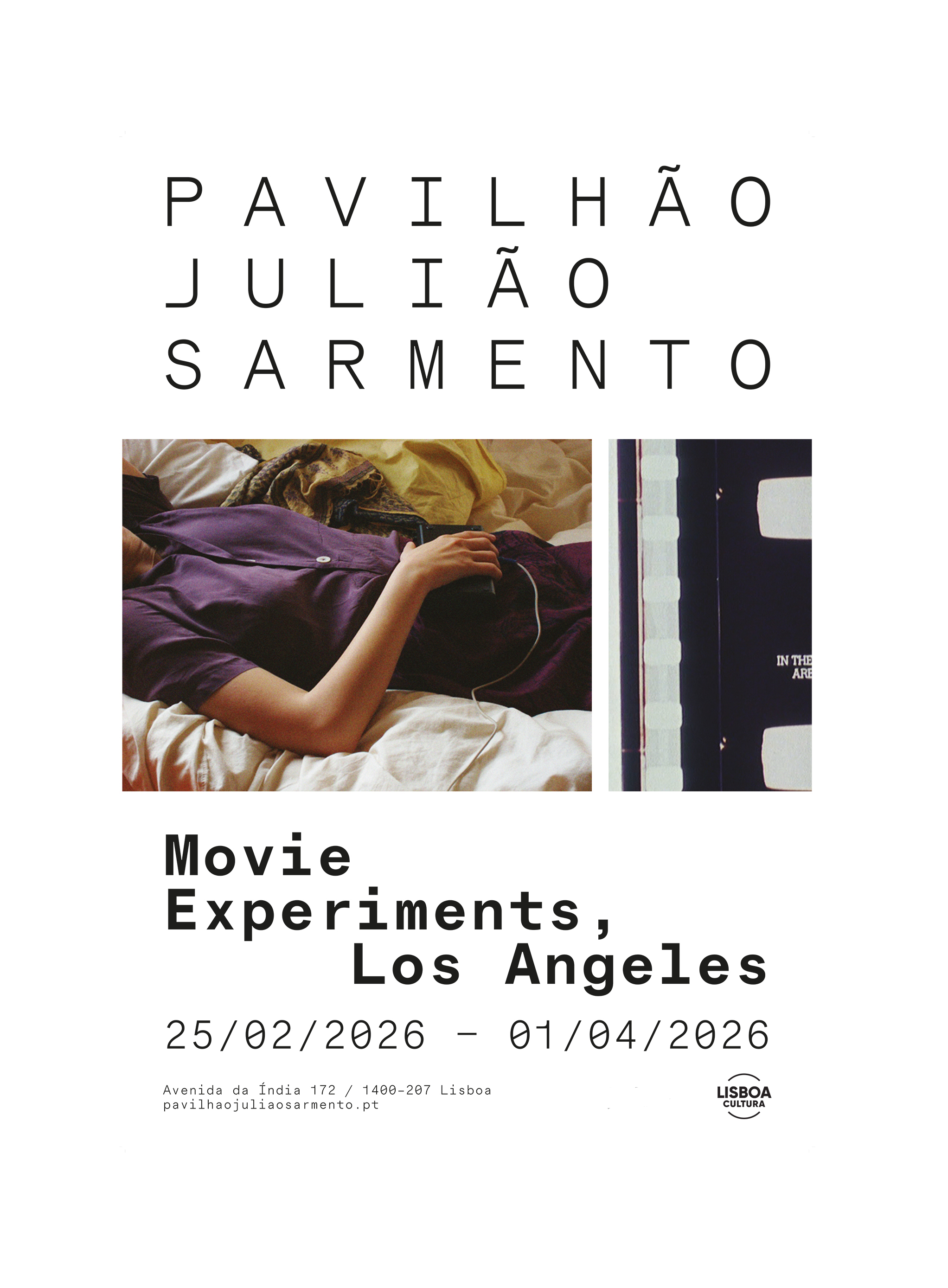
Movie Experiments
Pavilhão Julião Sarmento, Lisboa
25/02/2026-1/04/2026
curated by Andy Rector
Laida Lertxundi, Morgan Fisher
Thom Andersen and others.
“The angels of Los Angeles
Are tired out with smiling.”
Brecht, Hollywood Elegies
So the mouths make other shapes, and say something different… A film series over six Wednesdays at the Pavilhão Julião Sarmento. Six concentrated cinema programs of various Los Angeles film practices in collision- films selected and arranged on the grounds of their geographic derivation and fidelity to Los Angeles, and their exceptionally cinematographic form of being in that place. One could say it’s a collection of “the outliers” of Los Angeles, or even of experimental film itself, though what’s in evidence here is a city, and an apparatus, and its people, that has no true center, and is seen as such, interlocked in its realities.
The first program, “Origins,” exalts and exemplifies the sun and Pacific sea of Los Angeles, that element which drew so many populations there, particularly the “movies” (which was a derogatory term for film workers as they arrived in Los Angeles). One example from the program, The Salvation Hunters (Josef von Sternberg), with its three unemployed protagonists, describes not so much a horizontal panorama of Los Angeles, but a socially familiar vertical tilt of the place, from mud to sky. From the commercial Port of San Pedro, to the slums of downtown, to the undeveloped outskirts of the San Fernando Valley.
“At Odds,” the second program, begins with Wong Sinsaang (Eddie Wong) and the hiss of a steam press in a Hollywood neighborhood dry cleaning shop, in this portrait film of Wong Moon Tung, proprietor of the shop and Secretary of the Chinese Laundryman's Association, as seen by his newly politically conscious son. Thom Andersen’s refused ice cream sundae film, Melting, follows, and we end with the documentary-amplified fiction The Savage Eye (Ben Maddow, Sidney Meyers, Joseph Strick), a grim expression and critique of alienation containing more unreconciled people and shots of the city than any other film in the series.
“The Industrious Thom and Morgan” focuses on two of the most unique film practitioners in the medium’s history, Andersen and Fisher. Both set hard structural rules for their films, stark rigors that would determine the form of each film, as a way of avoiding purely individualist expressivity. This doesn’t discard subjectivity — in fact the films are idiosyncratic — rather, it produces “montage on a new plane” (Fisher), nakedly revealing subjective and objective history, autonomous shot elements, and some filmic transparency. In the single, unbroken 35-minute take of Standard Gauge — wherein Fisher shows us inert bits of 35mm film he’s collected from discard bins over the years while working marginal jobs in the film industry — one can’t imagine a more perfect unity of form and content, autobiography and determinism. Andersen’s Get Out of the Car is a joyous and melancholy city symphony film, overtly concerned with the past and present out in the streets. Andersen began filming “ruined billboards, which, I’m aware, is one of the most hackneyed subjects in contemporary art.” While recording the sound, the remarks of passersby became crucial, and he went further, overlaying music — generally one song fragment per shot — diegetically recorded as if coming out of a radio: finally, “the soundtrack is more important than the images.” And with good reason: through what he calls “militant nostalgia,” Andersen restores the musical heritage of Los Angeles’ Rhythm and Blues, mixed with contemporary music about the life of indocumentados.
In the vertiginous “Signs of Life” program, we have three shorts, three successive revolving objects, a “cinematic concordance of objects in some sense ontologically akin to motion pictures” (as Andersen described Morgan Fisher's Wilkinson Household Fire Alarm). This is followed by the freest film of all, a direct document of South Los Angeles poet, griot, and word musician Kamau Daáood, Life is a Saxophone (S. Pearl Sharp, Orlando Bagwell): an explosion of new African American classical music and oral tradition,a profusion of word-images, and a devastating rundown of society’s poisons. ''whole notes, not 16th notes, not 8th notes, whole notes,” Daáood chants during a line of his celebratory title poem, on the symbolic-material-historical transformation of the saxophone in Black American life. Out of the entire series, this film, through Daáood, asks us most directly about the function of art and statement.
The fifth program, “Inside and Outskirts,” consists of five different but united Los Angeles situations about the eases and difficulties of the production of happiness. Crumbling houses in arid antipodes; emptied and filled cars in urban alleyways; rustling bathwater used for three generations of women;the grinding-on of an Arriflex recording a young man’s dream. There are, in a way, too many matters at hand in these films to take account of, and that was a strategy of the programming: to project them together. All are films of a certain tactile glory and community intimacy. We have new ways of seeing domesticity and the domestic enclave, social time and space, the refuge of family and identity (lost, found, questioned, fortified), and the tensions of ritual, dream, and love.
The last program, “‘Hey Art, Art Wake Up, Man’” (a line of dialogue from The Exiles), could be characterized as “on intoxication.” The first two shorts,A Film Johnnie (George Nichols) and Aleph (Wallace Berman), are strange kin in their build-up of cultural detritus, their piles of images, and perhaps obsessions, as intertwined with the life of a local — a film fan (Chaplin’s Tramp) who happens to live near Mack Sennett’s Echo Park Keystone Studio, and Wallace Berman, collagist of Topanga Canyon. A more dire kind of drunkenness, with dilations, contractions, and suspensions of time, pervades, The Exiles (Kent Mackenzie), which portrays twelve hours compressed into 72 minutes in the life of Native Americans who’ve left the reservations to live in the Bunker Hill area of downtown Los Angeles (“the most concrete and detailed record we have of these doomed spaces,” wrote Thom Andersen). Highly sensitive to the gradations of hope and hopelessness in the real people it depicts, The Exiles invented new forms of cinematographic testimony and inner monologue in order to exist.
Andy Rector
Pavilhão Julião Sarmento
--
back
Pavilhão Julião Sarmento, Lisboa
25/02/2026-1/04/2026
curated by Andy Rector
Laida Lertxundi, Morgan Fisher
Thom Andersen and others.
“The angels of Los Angeles
Are tired out with smiling.”
Brecht, Hollywood Elegies
So the mouths make other shapes, and say something different… A film series over six Wednesdays at the Pavilhão Julião Sarmento. Six concentrated cinema programs of various Los Angeles film practices in collision- films selected and arranged on the grounds of their geographic derivation and fidelity to Los Angeles, and their exceptionally cinematographic form of being in that place. One could say it’s a collection of “the outliers” of Los Angeles, or even of experimental film itself, though what’s in evidence here is a city, and an apparatus, and its people, that has no true center, and is seen as such, interlocked in its realities.
The first program, “Origins,” exalts and exemplifies the sun and Pacific sea of Los Angeles, that element which drew so many populations there, particularly the “movies” (which was a derogatory term for film workers as they arrived in Los Angeles). One example from the program, The Salvation Hunters (Josef von Sternberg), with its three unemployed protagonists, describes not so much a horizontal panorama of Los Angeles, but a socially familiar vertical tilt of the place, from mud to sky. From the commercial Port of San Pedro, to the slums of downtown, to the undeveloped outskirts of the San Fernando Valley.
“At Odds,” the second program, begins with Wong Sinsaang (Eddie Wong) and the hiss of a steam press in a Hollywood neighborhood dry cleaning shop, in this portrait film of Wong Moon Tung, proprietor of the shop and Secretary of the Chinese Laundryman's Association, as seen by his newly politically conscious son. Thom Andersen’s refused ice cream sundae film, Melting, follows, and we end with the documentary-amplified fiction The Savage Eye (Ben Maddow, Sidney Meyers, Joseph Strick), a grim expression and critique of alienation containing more unreconciled people and shots of the city than any other film in the series.
“The Industrious Thom and Morgan” focuses on two of the most unique film practitioners in the medium’s history, Andersen and Fisher. Both set hard structural rules for their films, stark rigors that would determine the form of each film, as a way of avoiding purely individualist expressivity. This doesn’t discard subjectivity — in fact the films are idiosyncratic — rather, it produces “montage on a new plane” (Fisher), nakedly revealing subjective and objective history, autonomous shot elements, and some filmic transparency. In the single, unbroken 35-minute take of Standard Gauge — wherein Fisher shows us inert bits of 35mm film he’s collected from discard bins over the years while working marginal jobs in the film industry — one can’t imagine a more perfect unity of form and content, autobiography and determinism. Andersen’s Get Out of the Car is a joyous and melancholy city symphony film, overtly concerned with the past and present out in the streets. Andersen began filming “ruined billboards, which, I’m aware, is one of the most hackneyed subjects in contemporary art.” While recording the sound, the remarks of passersby became crucial, and he went further, overlaying music — generally one song fragment per shot — diegetically recorded as if coming out of a radio: finally, “the soundtrack is more important than the images.” And with good reason: through what he calls “militant nostalgia,” Andersen restores the musical heritage of Los Angeles’ Rhythm and Blues, mixed with contemporary music about the life of indocumentados.
In the vertiginous “Signs of Life” program, we have three shorts, three successive revolving objects, a “cinematic concordance of objects in some sense ontologically akin to motion pictures” (as Andersen described Morgan Fisher's Wilkinson Household Fire Alarm). This is followed by the freest film of all, a direct document of South Los Angeles poet, griot, and word musician Kamau Daáood, Life is a Saxophone (S. Pearl Sharp, Orlando Bagwell): an explosion of new African American classical music and oral tradition,a profusion of word-images, and a devastating rundown of society’s poisons. ''whole notes, not 16th notes, not 8th notes, whole notes,” Daáood chants during a line of his celebratory title poem, on the symbolic-material-historical transformation of the saxophone in Black American life. Out of the entire series, this film, through Daáood, asks us most directly about the function of art and statement.
The fifth program, “Inside and Outskirts,” consists of five different but united Los Angeles situations about the eases and difficulties of the production of happiness. Crumbling houses in arid antipodes; emptied and filled cars in urban alleyways; rustling bathwater used for three generations of women;the grinding-on of an Arriflex recording a young man’s dream. There are, in a way, too many matters at hand in these films to take account of, and that was a strategy of the programming: to project them together. All are films of a certain tactile glory and community intimacy. We have new ways of seeing domesticity and the domestic enclave, social time and space, the refuge of family and identity (lost, found, questioned, fortified), and the tensions of ritual, dream, and love.
The last program, “‘Hey Art, Art Wake Up, Man’” (a line of dialogue from The Exiles), could be characterized as “on intoxication.” The first two shorts,A Film Johnnie (George Nichols) and Aleph (Wallace Berman), are strange kin in their build-up of cultural detritus, their piles of images, and perhaps obsessions, as intertwined with the life of a local — a film fan (Chaplin’s Tramp) who happens to live near Mack Sennett’s Echo Park Keystone Studio, and Wallace Berman, collagist of Topanga Canyon. A more dire kind of drunkenness, with dilations, contractions, and suspensions of time, pervades, The Exiles (Kent Mackenzie), which portrays twelve hours compressed into 72 minutes in the life of Native Americans who’ve left the reservations to live in the Bunker Hill area of downtown Los Angeles (“the most concrete and detailed record we have of these doomed spaces,” wrote Thom Andersen). Highly sensitive to the gradations of hope and hopelessness in the real people it depicts, The Exiles invented new forms of cinematographic testimony and inner monologue in order to exist.
Andy Rector
Pavilhão Julião Sarmento
--
back